Activated Carbon Filter vs HEPA: They Solve Different Problems
They Are Not Competing Technologies
HEPA and activated carbon filters address completely different types of air contaminants. Framing this as a choice between them is a misunderstanding of what each does.
**HEPA (High Efficiency Particulate Air) filters** capture particles by forcing air through a dense mat of fibers. Particles get trapped through three mechanisms: inertial impaction (large particles), interception (mid-size particles), and diffusion (small particles). True HEPA must capture 99.97% of particles 0.3 microns or larger — this includes dust, pollen, pet dander, mold spores, bacteria, and smoke particles.
HEPA does not capture gases. VOCs, formaldehyde, cooking odors, and chemical fumes are molecules, not particles, and they pass through HEPA fiber without being captured.
**Activated carbon filters** adsorb gases by trapping gas molecules on the porous surface structure of the carbon. Carbon has an enormous surface area per unit weight (up to 3,000 square meters per gram) that gas molecules bind to. This removes odors, VOCs, and chemical vapors from the air.
Carbon does not capture particles. Dust and dander are too large to enter the porous structure and pass through carbon beds without being filtered.
When You Need HEPA
HEPA is the right filtration type when your primary concern is particles:
- Dust and dust mites (allergen is in the fecal particles, 10-30 microns)
- Pet dander (Fel d 1 protein particles, 2.5-10 microns)
- Pollen (10-100 microns — HEPA over-captures this easily)
- Mold spores (3-100 microns)
- PM2.5 from wildfire smoke (particles under 2.5 microns — HEPA handles this)
- Bacteria (0.5-5 microns)
If you have allergies, asthma, or respiratory conditions triggered by particulates, HEPA is essential. The AAFA (Asthma and Allergy Foundation of America) recommends True HEPA specifically — not HEPA-type, HEPA-like, or HEPA-grade filters, which do not meet the 99.97% standard.
When You Need Activated Carbon
Carbon is the right filter when your primary concern is gases and odors:
- Cooking odors (aldehydes and alcohols from high-heat cooking)
- Tobacco and cannabis smoke (both particulate — HEPA — and chemical — carbon)
- Pet odors beyond dander (urine compounds, general animal smell)
- VOCs from new furniture, flooring, or paint (formaldehyde, benzene, toluene)
- Chemical fumes (cleaning products, hobby supplies, craft materials)
- Automotive exhaust transfer from attached garages
The Question Is Carbon Quality, Not HEPA vs Carbon
Most air purifiers sold today include both HEPA and a carbon layer, so the question is not which technology to choose but how much carbon you need.
As covered in more detail in our guide to VOC removal, carbon amount is the critical variable. A 2-oz carbon layer handles everyday odors. It does not meaningfully reduce VOC off-gassing or sustained chemical exposure. For that, you need 10-15 lbs of carbon — which means a purpose-built VOC purifier (Austin Air, IQAir GC MultiGas) rather than a standard HEPA unit with a thin carbon pre-filter.
Filter Replacement Timing
HEPA and carbon filters wear out differently and require independent attention:
**HEPA replacement**: Typically every 12-18 months for continuous use. A HEPA filter that looks gray or brown has captured a lot of particles — this is not a sign of failure. Replace when airflow drops noticeably or when the manufacturer's timeline is reached.
**Carbon replacement**: Every 6-12 months for standard use, more frequently in high-odor or high-VOC environments. Carbon saturates gradually — you will notice it is saturating when odors start returning before the filter is due for replacement. Unlike HEPA, a carbon filter does not give visual feedback about saturation.
Summary Table
| | HEPA | Activated Carbon |
|---|---|---|
| Captures particles | Yes (99.97% at 0.3 microns) | No |
| Removes gases and odors | No | Yes |
| Handles smoke | Partial (particles only) | Partial (gases only) |
| Handles VOCs | No | Yes (if enough carbon) |
| Handles allergens | Yes | No |
| Replacement frequency | 12-18 months | 6-12 months |
Affiliate Disclosure
Clean Air Picks participates in the Amazon Associates program. We earn a small commission from purchases made through our links at no additional cost to you. This helps us maintain and improve our site while providing honest, unbiased reviews.
Recommended Products
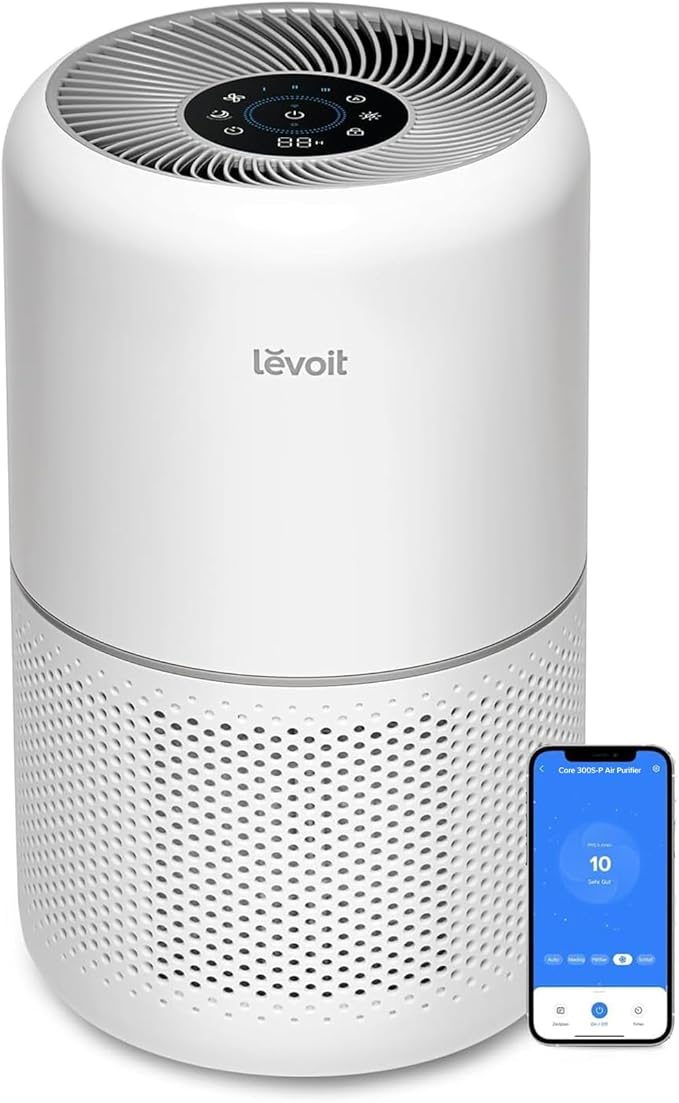
Levoit Core 300S
Budget
Check price
Compact air purifier with H13 HEPA filter for small to medium rooms.
View on Amazon →
Levoit Vital 200S
Budget
Check price
Smart air purifier with app control and auto mode for allergies.
View on Amazon →
Coway Airmega 400
Premium
Check price
Advanced ionization with dual-sided air intake for large rooms.
View on Amazon →
Dyson Purifier Cool
Premium
Check price
Combines air purification with cooling fan function.
View on Amazon →
Winix 5510
Mid-Range
Check price
Successor to the 5500-2 with True HEPA, carbon filtration, PlasmaWave, and app support.
View on Amazon →
Blueair Blue Pure 211+
Mid-Range
Check price
Swedish design with high CADR and quiet operation.
View on Amazon →
Honeywell HPA300
Mid-Range
Check price
Reliable HEPA filtration with three cleaning levels.
View on Amazon →

Alen BreatheSmart 75i
Premium
Check price
Whisper-quiet premium purifier for large spaces.
View on Amazon →
Molekule Air Pro
Premium
Check price
Advanced photoelectrochemical oxidation technology.
View on Amazon →
GermGuardian AC5250PT
Budget
Check price
Compact with germicidal UV-C light technology.
View on Amazon →

Levoit Air Purifier Pro
Mid-Range
Check price
Smart WiFi enabled with real-time air quality monitoring.
View on Amazon →
Airthings Renew Air Purifier
Smart
Check price
For bedrooms where you want to see the air quality, not guess. Built-in particulate and humidity sensors with an auto mode that ramps with the room. HEPA handles fine particles down to PM1. The catch: no carbon stage, so it does little for odors or gases.
Buy Direct →
Austin Air HealthMate
Premium
Check price
If you deal with smoke, chemicals, or strong odors, this is the heavy hitter. Medical-grade HEPA plus 15 lbs of activated carbon and zeolite, rated for rooms up to 1500 sq ft, with filters that last about 5 years. You pay for it in price and weight.
Buy Direct →
AirFree P2000
Filterless
Check price
A filterless purifier that heats incoming air to destroy mold, bacteria, and dust mites, so there is nothing to replace and no filter cost. The tradeoff is real: it does not capture dust or large allergens the way a HEPA unit does, so pair it with one if particles are your problem.
Buy Direct →
EyeVac Air Touchless Vacuum and Air Purifier
Specialty
Check price
A floor vacuum and air purifier in one, made for entryways and pet areas. Sweep debris to the touchless sensor base and it pulls it in, while the HEPA side handles airborne dust. As a pure air purifier, a dedicated HEPA unit moves more air for the money.
Buy Direct →